
Check Ellis County's Owner Card
Ellis County's Real Property Portal is the natural first stop for a current-owner search. The county advertises lookup routes by Address, Name, County ID, and Section-Township-Range. A public result card sits behind login, so plan to confirm field visibility live. When the card opens, record the owner name, parcel key, situs, mailing address, legal description, value year, and any transfer reference on screen.
| Owner of record | The person, trust, estate, or company named on the roll when checked |
|---|---|
| Parcel key | County ID or full CAMA number connecting the card to other systems |
| Mailing address | Where tax notices go, not proof of the owner's residence |
| Situs address | The physical property location |
| Legal description | Lot, block, addition, or section-township-range identity |
| Check date | The date the changing administrative roll was viewed |
The owner of record is often not the occupant. A rural parcel can carry a Hays mailing address yet sit outside the city. An entity, meanwhile, may take mail through an agent. Save a dated printout when the answer matters. It can settle a purchase, an estate, or a boundary question.
The official public portal entry screen shows the route that begins the current-owner check.
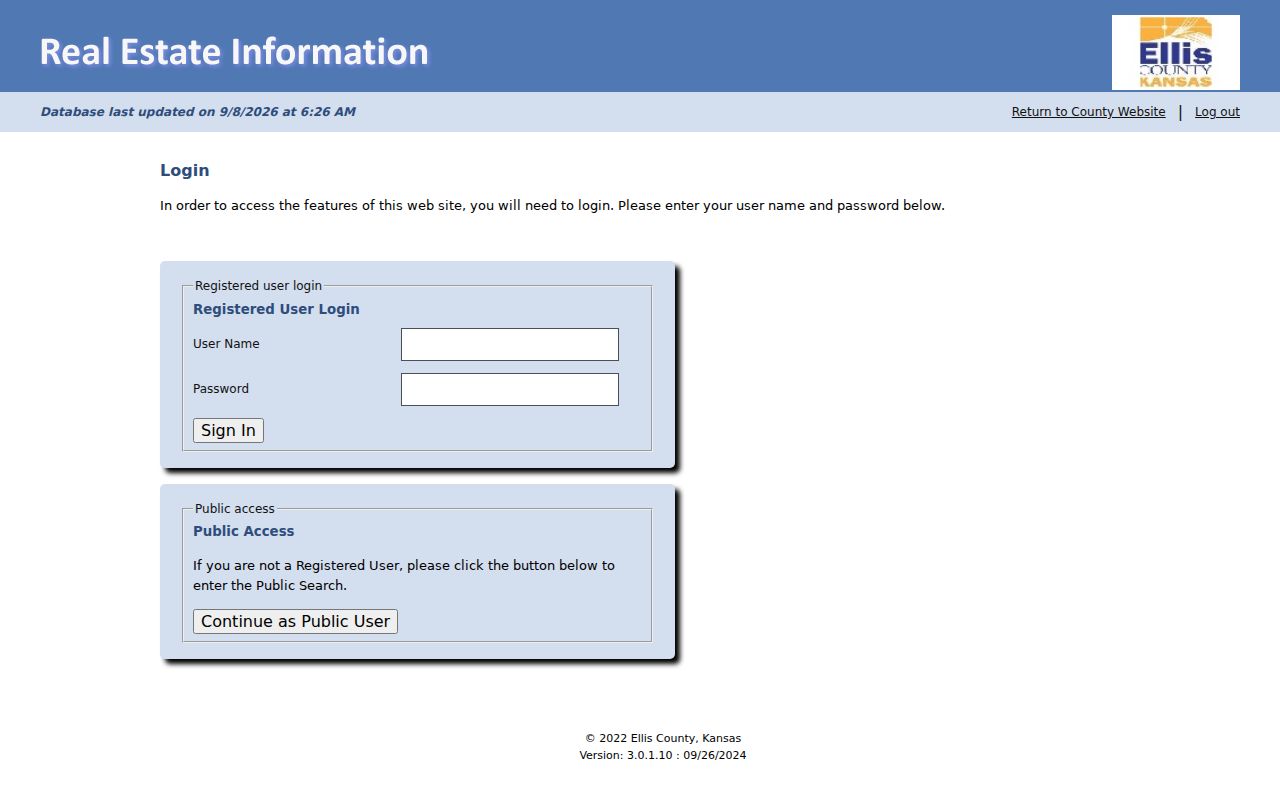
The screen is only a starting point. Parcel keys plus the newest deed make the answer verifiable.
Confirm Who Owns Ellis Property Now
Ellis County Register of Deeds keeps the official index of real-estate instruments, searchable by owner name and legal description. The office publishes no public online deed index, so confirming the owner of record takes a direct request. Call 785-628-9450, stop by 718 Main Street in Hays, or send a focused written request whenever an online owner card needs a second check.
- Pull the county card by exact address and copy its displayed owner and parcel identity.
- Ask the recorder for conveyances filed after the card's latest visible transfer date, if one appears.
- Match the newest grantee and complete legal description to the subject tract.
- Record the book/page or instrument reference and the date each source was checked.
- Grantee
- The party receiving an interest in a recorded conveyance.
- Vesting
- The deed language stating how title is held.
- Registered agent
- An entity's official contact, not proof of residence or beneficial ownership.
Time the Ellis Owner Roll
The Appraiser reports that at least 17 percent of county parcels get physically reinspected each year. That works out to roughly 2,700 parcels. In 2026 that field work runs from April into summer or fall. Notices of Value go out March 1. Those dates describe appraisal cycles. They say nothing about how fast a recorded deed becomes the current owner on the roll. A deed can be recorded for weeks. The roll may still show the prior owner of record.
Ellis County publishes no fixed deed-to-roll lag. A just-recorded deed can outrun the owner card. A newly indexed instrument might not be a transfer at all. It could be a mortgage, easement, lien, or partial-interest filing. Read the document type and land description before changing your answer.
Present-owner rule. When sources conflict, verify the recorded document with the Register of Deeds and ask the Appraiser whether the roll has processed it.
Note: Attach the check date to every Ellis County current-owner result, because the public roll is not promised in real time.
Recognize Ellis Ownership Changes
Not every current owner arrives by warranty deed. The county's December 2025 real-property transfer report listed quit claim deeds and death certificates or inheritance tax letters. It also included transfer-on-death deeds, trustee's deeds, corporation deeds, divorce, probate, and other instruments. Searching one deed label alone can miss the most recent change.
For a death-related transfer, compare the recorder's instrument with any public probate material. Kansas CaseSearch offers basic district-court case information. Older or document-level access may take a courthouse terminal or a clerk request. Sealed records stay unavailable.
Copy trust and company names exactly. The trustee or agent receiving mail is not automatically the beneficial owner or the resident. The deed's vesting words and the parcel description establish the land connection.
Verify the Ellis Owner Parcel
Open ORKA with the County ID and legal description in hand. The ownership map supplies spatial context and advertises aerial imagery back to 2014. It shows whether the address and parcel shape seem to describe the tract in question. Map lines are not a survey. An owner label can also lag behind a transfer. A map check prevents some wrong-lot errors but cannot establish title. So compare the recorded plat and deed for fractional lots, additions, and farm tracts.
The county Maps hub layers on city, tax-district, township, school, and improvement-district context. Those overlays explain jurisdiction. They do not settle ownership.
Annexation can change the city label or planning office without restarting the deed chain. That matters near Hays, Ellis, and Victoria. Current municipal context there may differ from an older addition or survey description. Preserve both labels and let the parcel key connect them.
Monitor Current Ellis Recordings
Once ownership is confirmed, the free Recording Notification Service is available. It can alert an enrolled owner whenever a document is recorded against the property. It does not judge whether a filing is valid. It does not replace a deed review. Treat any alert as a reason to call the recorder.
The service also works as a shield against paid-looking mail. A fee demand or official-looking fraud notice deserves a second look. Verify it by opening the county page directly. You can also use the published Register of Deeds number. Never trust a phone number printed only on a solicitation. Keep the alert, the envelope, and any recording reference. Then ask the recorder whether the document affects the exact legal description, and whether a copy is available. The service monitors recordings only. It does not watch unrecorded conduct. It does not decide title, and it does not guarantee a notice for every name variant.
Use Ellis Owner Data Responsibly
A mailing address serves one narrow purpose. Kansas Safe at Home issues substitute addresses and forwards mail for eligible survivors, so never read an agent, trustee, company, or substitute address as proof of where the owner of record actually lives.
The Ellis County KORA form asks for a detailed request and certification against prohibited list use. KORA never forces an office to create a new database or answer a research question. Preparation and copy costs are allowed. A custodian may request advance payment.
Found a mistake on a public card? Give the parcel key, the field shown, the source document, and the date checked. Deed corrections belong with the recorder. Appraisal-roll ownership and mailing fields belong with the Appraiser, and keeping those duties separate avoids asking one office to alter another office's record.
Lawful use. Current-owner records support purchases, estates, deed-fraud checks, and boundary contact. Never use them to stalk, harass, threaten, or build a bulk address list.
Send corrections to the office that maintains the field. The Appraiser controls its roll. The Treasurer holds the tax data, and the Register of Deeds holds each recorded instrument.
A concise verification note lists the displayed owner, the parcel identifier, the legal description, source URLs, the latest recording reference, and each check date. If the card and deed still disagree after both offices respond, describe the conflict instead of picking the more convenient name. The method matters as much as the result.