
Identify an Ellis County Owner
Start at the Ellis County Real Property Search Options page. The county supports searches by address, name, County ID, and section-township-range. Try the physical, or situs, address first. Write down the owner name exactly as it appears. Keep the County ID, mailing address, legal description, and value year beside it. Those keys let you pull the same tract up in the map, tax, and deed systems. You can do it without starting over. Remember that the appraisal roll exists for valuation and tax administration. It identifies the owner of record well. But it does not by itself prove how title moved. For that, the recorded conveyance is the stronger evidence. And each step builds on the one before it.
- Enter the exact street address in the public Real Property Portal and continue as a public user.
- Copy the owner name, County ID or CAMA number, situs address, mailing address, and full legal description.
- Use Ellis County ORKA to check that the parcel shape and mapped location match the subject land.
- Ask the Register of Deeds for the latest deed indexed to that name and legal description.
Hang onto the deed's book and page or instrument reference. It makes your owner answer reproducible, and it gives a title professional a clean starting point if the chain needs a closer look.
Compare Ellis County Address Fields
The situs address shows where the parcel sits. The mailing address shows where the county sends tax bills. Nothing requires the two to match. A rural owner may get mail through Hays. The land may sit outside the incorporated city. A trust, company, estate, or nonresident owner may rely on an agent or office address instead. This matters when you ask who owns an Ellis County property. The mailing field proves nothing about occupancy. Copy both fields separately, and let the County ID and legal description settle any ambiguity. ZIP codes describe delivery geography, not municipal or parcel boundaries.
- Situs address
- The physical location assigned to the parcel.
- Mailing address
- The destination used for tax notices and correspondence.
- Owner of record
- The owner name carried on the county's administrative roll.
- Legal description
- The lot, block, addition, section, township, range, or tract language that identifies the land.
Note: Carry the owner name and legal description together, because common surnames and neighboring fractional lots can otherwise produce a false match.
Ellis County Ownership Evidence
Each official source answers a different slice of the owner question. No single screen substitutes for the rest. The most dependable answer ties the roll, the mapped parcel, and the latest deed together through identical parcel facts.
| Official source | Ownership clue | How to reach it |
|---|---|---|
| Real Property Portal | Owner of record, parcel identity, situs and mailing context | Public online login; county also lists office help |
| ORKA ownership map | Mapped parcel and ownership or valuation context | Online acceptance screen and map |
| Register of Deeds | Grantee and legal description on the latest conveyance | Office, phone, mail, or written records request |
| Treasurer tax module | Taxpayer and property criteria tied to a tax year | Online tax search |
The recorder publishes no public online grantor-grantee search for Ellis County deed records. No coverage cutoff appears in the official material either. The web route can stop short. Contact the recorder's office directly when it does. Staff can confirm the parcel number, owner of record, and deed copies you need.
Trace an Ellis County Deed
A deed names the grantor, who transfers an interest, and the grantee, who receives it. The Register of Deeds reviews eligible documents. It assigns recording references. It also indexes names and legal descriptions. Ask for the most recent instrument affecting your exact tract. Then match its grantee and legal description to the owner roll. Do that before deciding who owns the property. A warranty deed is not the only transfer route, either. Ellis County's December 2025 transfer report included quit claim deeds and transfer-on-death deeds. It also listed trustee's deeds, corporation deeds, probate, divorce, and death or inheritance documents. An owner search limited to one deed label can miss a valid transition.
Fresh recording rule. When a new deed and the owner roll disagree, obtain the recorded instrument and ask the Appraiser about the roll update rather than guessing from either date.
The county publishes no fixed deed-to-roll delay. A recent deed may therefore be more current than a roll card that has not yet caught up.
Why Ellis County Owners Differ
The Appraiser maintains the roll on an annual administrative cycle. It physically reinspect at least 17 percent of parcels each year. That inspection schedule supports valuation work. It does not promise same-day processing of every conveyance. Annual Notices of Value and appraisal field work run on their own calendar. They sit separate from the moment a deed is recorded. Some differences are harmless. A deed may vest title in a trust while the mailing line names a trustee. A company may list a registered office. A probate order can move an interest before every downstream screen reflects it. Compare names exactly. Check recording dates. Then use the legal description to confirm both records concern the same land.
Note: Ellis County publishes no fixed update lag, so a responsible owner answer should include the date each source was checked.
Read Trust and Estate Owners
Sometimes the owner of record is not a person at all. The field may show a trust, an estate, a corporation, or a limited-liability company. Copy the name exactly. Keep every initial, comma, and trustee phrase as written. Then ask the recorder for the deed or probate instrument that put that name into the chain of title. The deed proves the land connection; an entity filing can reveal an agent, but it never substitutes for the deed itself.
Estate transfers need extra patience. Probate files may sit with the Ellis County District Court, while the recorder may hold a transfer-on-death deed, trustee's deed, or other death-related filing. Some court material appears through Kansas CaseSearch. Older or document-level access can still require a courthouse terminal or the clerk. Sealed and confidential material stays off limits.
Search with the exact party name plus a date range. Then loop back to the parcel's legal description. That cross-check keeps a similarly named trust from being pinned to the wrong Ellis County property owner.
Watch New Ellis County Recordings
Once the owner is settled, Ellis County offers a way to stay watchful. The county's free Recording Notification Service sends an alert when a document is recorded against a property. It is a monitoring aid, nothing more. It is not a deed index. It does not prove a filing is valid. Treat any alert as a prompt to check directly with the Register of Deeds.
The service doubles as a scam check. A paid-looking letter offering a deed copy or fraud alert deserves comparison with the official county page and the published recorder number before any money changes hands. Suspect fraud? Keep the envelope and the demand.
For context, the official notification screen appears alongside. The county RNS page explains the free local service.
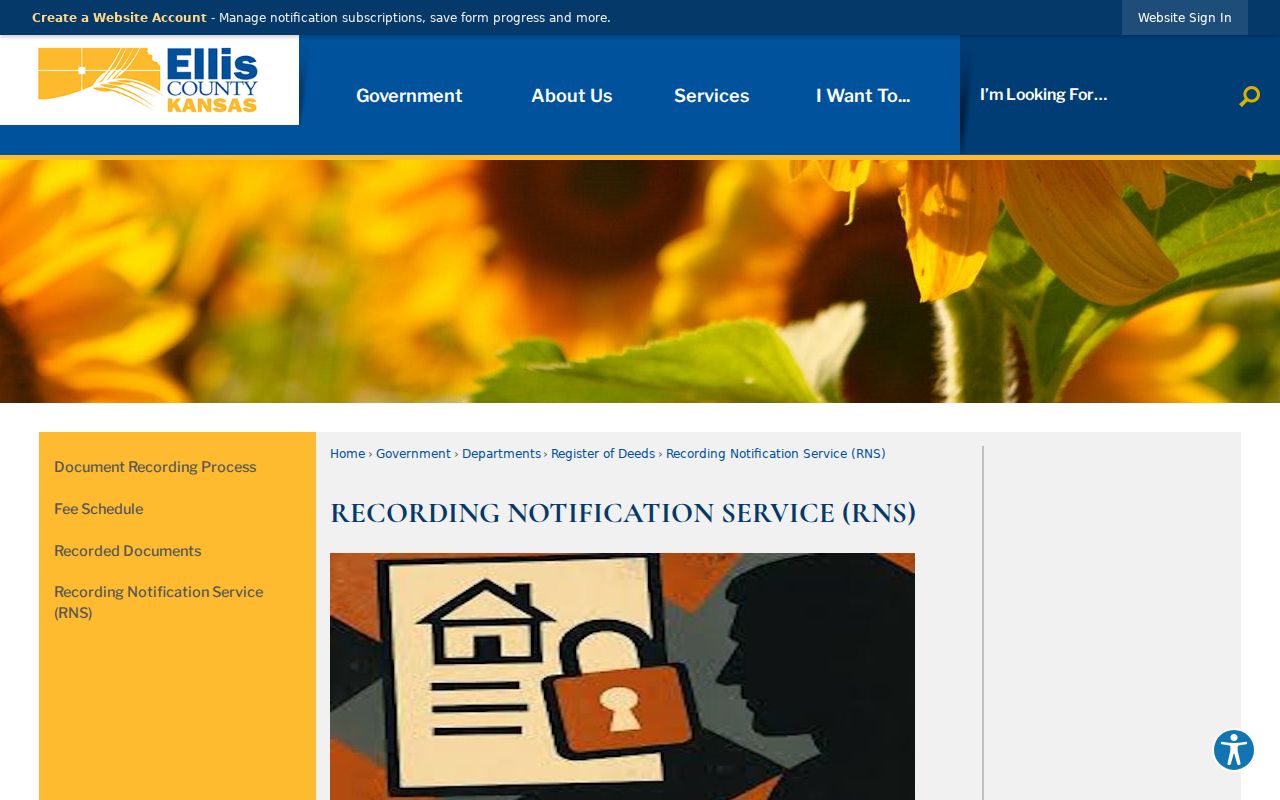
The page confirms the point: an alert supplements, never replaces, deed and owner-of-record checks.
Limits of Ellis County Owner Records
An owner-of-record entry has firm edges. It does not list every occupant, beneficial interest, lease, unrecorded claim, or title defect. ORKA serves property ownership and valuation context. Its parcel lines are no substitute for a boundary survey. A records search is not title insurance. It is not a title examination either.
Kansas Open Records Act access carries reuse limits as well. Ellis County's public-record request form demands a detailed request and certification against prohibited list use. ORKA restates the Kansas ban on using public name-and-address lists to sell property or services. Search one parcel for due diligence, boundary context, estate work, or house history. Do not scrape the directory.
Lawful use. Ellis County owner information must not be used to stalk, harass, threaten, or infer that a protected mailing address is someone's residence.
Kansas Safe at Home can supply a substitute mailing address for eligible survivors. Respect that protection. Route correction requests to the office that created the record.
If the portal fails, keep the fallback chain tight. Call the Appraiser at 785-628-9400 for the owner field. Contact the recorder for the latest conveyance. Use a written KORA request for a named existing record. Ask for the record itself. Do not ask for an office opinion about title. That distinction keeps public access and legal analysis in their proper lanes.